

You need a clear path to fund your rental deals, and the paperwork can trip you up fast. A solid mortgage application checklist lets you pull together the right pieces, avoid surprise requests, and close faster. In this guide you’ll walk through every step of the investor‑focused process, see the exact docs you’ll need, learn how rates stack up in 2026, and run a cash‑flow example that shows you the numbers before you sign. Let’s get you ready to submit a clean, investor‑ready file.
What Is a Mortgage Application Checklist for Investors?
A mortgage application checklist is simply a list of the documents and data points a lender will ask for before they approve a loan. For investors the list looks a bit different than for a primary‑home buyer because the focus is on the property’s ability to generate cash, not on your personal pay stubs.
The checklist covers three buckets: personal credit health, property financials, and the paperwork that proves you can close. It helps you stay organized, cuts down on back‑and‑forth emails, and shows the lender you’re serious.
When you pull together the right pieces ahead of time, you can move from pre‑approval to funding in weeks instead of months. That speed matters when a seller wants a clean offer.
Investors often qualify on debt service coverage ratio (DSCR) instead of debt‑to‑income. That means the lender looks at the rent you expect to collect versus the loan payment. The checklist will therefore ask for rent schedules, market rent comps, and a brief operating statement.
Below is a quick snapshot of the core items you’ll need:
- Credit report and score.
- Proof of reserves (cash or liquid assets).
- Purchase contract.
- Rental income analysis (rent roll, market comps, DSCR calculation).
- Property appraisal.
- Insurance binder.
- Entity documents if you buy through an LLC.
Keeping this checklist handy means you won’t be caught off guard when the lender asks for “the last two months of bank statements” or “the rent roll for the past 12 months.” It also makes it easier for your broker to shop lenders fast.
For more about my background and how I help investors simplify the process, see About Duane – Low Cost Mortgage. I’ve closed over $51 million in solo‑producer volume, so I know the exact paperwork lenders love.
How the Investor Mortgage Application Process Works
First, you sit down with a broker who understands DSCR loans. I’ll ask you about the property, the expected rent, and your credit score. Then we run a quick pre‑qualification to see what loan size you can expect.
Next, you gather the docs from the checklist. Upload them securely to our portal, and we submit them to the lender’s underwriting system. Most lenders run the application through an automated underwriting engine like those commonly used in the industry. If the system flags anything, a human underwriter steps in.
While the software reviews, the lender will order a property appraisal. The appraiser checks the condition and compares the property to recent sales and rentals in the area. That appraisal feeds into the lender’s rent‑cap analysis.
After the appraisal, the underwriter looks at your credit, reserves, and the rent‑roll you provided. For a DSCR loan, they will typically count 75 % of the projected rent toward your qualifying income. If the debt‑service coverage ratio (projected rent ÷ monthly payment) is above 1.0, you’re in good shape.
Once the underwriter signs off, the loan goes to final approval. You’ll receive a loan commitment letter that outlines the rate, fees, and any conditions. Satisfy any conditions (like proof of insurance) and you head to closing.
That’s the high‑level flow. Below is a visual cue of the steps.

And here’s a short video that walks through each stage in a few minutes.
Pro tip: Keep a digital folder named “Investor Mortgage Docs” and drop each file as soon as you get it. That way you never lose a receipt and the lender can pull the file instantly.
Mortgage Application Requirements for Real Estate Investors
When you apply for an investment loan, the lender will focus on three areas: credit, cash reserves, and the property’s projected income. Below is a deeper look at each requirement.
Credit score. Most conventional investment loans want a score in the high‑600s. DSCR programs often raise the floor to 680 because they rely less on personal income and more on the property’s cash flow.
Cash reserves. Lenders want to see that you can cover at least six months of mortgage payments on top of the down payment. That reserve shows you can weather a vacancy.
Down payment. Expect to put down 15‑25 % for most investment loans. For DSCR loans, a 25 % down payment often yields the best rates.
Rental income documentation. Provide a rent roll, a market rent analysis, and a signed lease if the unit is already occupied. Lenders will usually count 75 % of the projected rent toward your qualifying income.
Property appraisal. The appraiser will verify the value and check that the property meets basic safety and habitability standards. They’ll also provide a rent‑cap estimate that the lender uses in the DSCR calculation.
Entity documents. If you buy through an LLC, you’ll need the Articles of Organization, EIN, and operating agreement.
Here’s a quick checklist you can print:
- Credit report and score.
- Proof of cash reserves (bank statements, investment statements).
- Purchase contract.
- Rent roll and market rent comps.
- Appraisal report.
- Insurance binder.
- Entity formation documents (if applicable).
These requirements line up with what the Consumer Financial Protection Bureau notes about standard mortgage documentation Consumer Financial Protection Bureau. They also match the trends we track.
And remember, a DSCR loan can skip the personal tax returns that most investors have to provide for a conventional loan. That’s a big time‑saver.
Mortgage Application Rates and Costs in 2026
Investment property rates sit a notch above primary‑home rates because lenders see extra risk. In 2026 the spread is typically 0.5‑0.75 % higher.
For example, a 30‑year fixed loan on a $400,000 single‑family rental with a 20 % down payment might carry a rate of 6.8 % versus 6.2 % for an owner‑occupied loan. Those extra points can shave a few hundred dollars off your monthly cash flow.
DSCR loans are currently hot, and lenders are offering competitive rates to attract investors. A recent analysis from the HUD office shows that average investment loan rates have hovered around 6.5 % this year HUD. That figure reflects both fixed‑rate and adjustable‑rate products.
When you shop rates, look beyond the APR. Factor in lender fees, points, and any mortgage‑insurance premiums that might apply if your loan‑to‑value (LTV) exceeds 80 %.
Closing costs for investment loans can run 2‑5 % of the loan amount. That includes appraisal fees, title insurance, and attorney fees. Some lenders offer a lender‑credit that can offset a portion of those costs if you accept a slightly higher rate.
Here’s a quick tip: If you have a strong credit score and a solid reserve, you can often negotiate a lower rate by offering a higher down payment. The math works out quickly when you run the numbers.
Worked Example: Rental Property Cash Flow Analysis
Let’s run a real‑world example using current market data. Imagine you’re eyeing a single‑family home in Henrico County, Virginia. The median home price there is $415,000.
You find a property listed for $350,000. You decide to put 25 % down ($87,500). That leaves a loan amount of $262,500.
Assume you qualify for a DSCR loan at a 7.5 % interest rate on a 30‑year term. The principal‑and‑interest (P&I) payment works out to about $1,836 per month.
Market rent in Henrico County for a comparable unit is $2,100 per month. Using the DSCR formula, we get:
DSCR = projected rent ÷ P&I payment = 2,100 ÷ 1,836 ≈ 1.14.
Since 1.14 is above the 1.0 minimum, the loan meets the coverage requirement.
Now add the other monthly costs:
- Property tax (approx. $300).
- Insurance (about $120).
- Management fee (10 % of rent = $210).
- Reserve for repairs (5 % of rent = $105).
Total monthly outflow = 1,836 + 300 + 120 + 210 + 105 = $2,571.
Net cash flow = rent , total outflow = 2,100 , 2,571 = , $471.
In this scenario the property is cash‑flow negative, but you could improve the numbers by raising rent, reducing the interest rate, or increasing the down payment.
Here’s a simple table to see the breakdown:
Seeing the numbers laid out helps you decide if the deal fits your portfolio goals. If you need positive cash flow, you might look for a property with higher rent or negotiate a lower rate.
Blockquote: “A well‑run cash‑flow analysis can turn a good deal into a great one.”
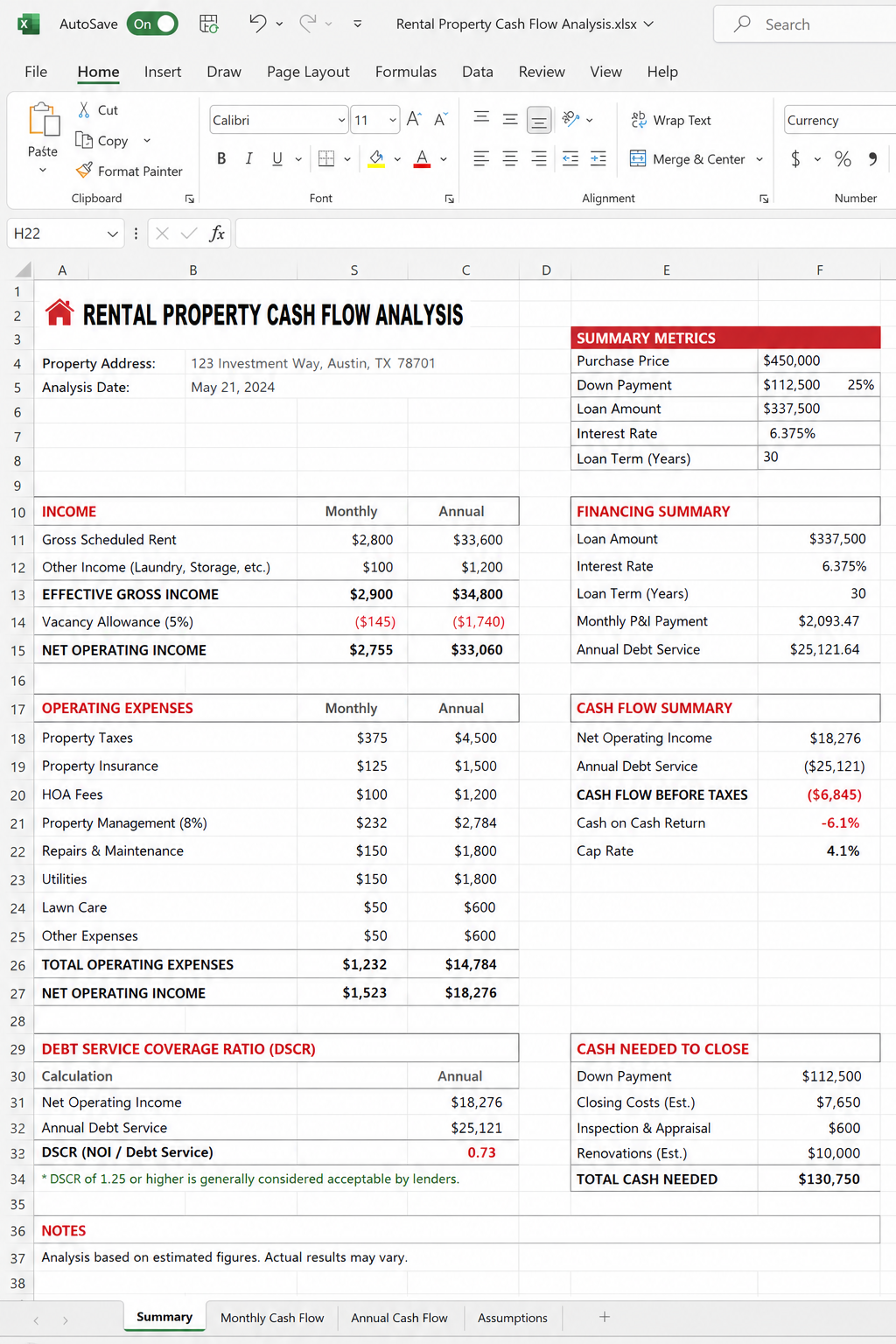
Pro tip: Use a spreadsheet template that automatically calculates DSCR and cash‑on‑cash return. It saves time and reduces errors.
Investor Mortgage Checklist vs Homebuyer Checklist: Comparison Table
Investors and primary‑home buyers share some paperwork, but the focus differs. Below is a side‑by‑side view.
The investor checklist adds a rent‑roll and DSCR focus, while the homebuyer list leans on personal income verification.
For a deeper look at how we handle these items, visit our Credit Restoration page. Strong credit can lower your rate dramatically.
Frequently Asked Questions
What DSCR ratio do I need to qualify?
Most lenders require a debt‑service coverage ratio of at least 1.0. That means the projected rent must cover the monthly loan payment. Many investors aim for 1.2 or higher to build a cushion against vacancies or maintenance costs.
Can I use projected Airbnb income for a DSCR loan?
Yes, if you can provide a solid market analysis. Lenders will typically count 50‑75 % of short‑term rental projections, depending on the property’s location and seasonality. You’ll need a rent‑cap estimate from an appraiser familiar with short‑term rentals.
How many DSCR loans can I have at one time?
There isn’t a hard cap, but each loan will be evaluated against your overall debt load and cash reserves. Most lenders look for a combined DSCR of at least 1.0 across all properties, so you’ll need enough reserves to cover multiple payments.
Is a DSCR loan available for a 2‑4 unit property?
Absolutely. DSCR programs work with multifamily buildings up to four units. The lender will evaluate the combined rent from all units, apply the 75 % factor, and compare it to the total loan payment.
What is the minimum credit score for a DSCR loan?
Most DSCR lenders set the floor at 680, though a score of 720 or higher can unlock the best rates. If your score is lower, you might need a larger down payment or higher reserves.
Do I need a personal guarantee on a DSCR loan?
Many DSCR loans do not require a personal guarantee if the property’s cash flow is strong enough. However, some lenders still ask for a guarantee if the DSCR is close to 1.0 or if the borrower has limited reserves.
Can I refinance an existing investment property with a DSCR loan?
Yes. Refinancing can lower your rate or free up cash for another purchase. You’ll still need to provide the rent‑roll and DSCR calculation for the new loan terms.
How do lender fees differ for investors?
Investors typically see higher origination fees (often 1‑1.5 % of the loan) and larger appraisal costs because the lender orders a rent‑cap analysis in addition to the standard market value appraisal.
Why Work With Duane Buziak at Invest Mortgage
I’m a solo producer with $51.2 million in independently verified loan volume. That means every deal gets my personal attention from start to finish.
Being named a Top Originator 2025 and 2026 shows I consistently beat the competition on rate, speed, and client satisfaction. I’m also Virginia Broker of the Year for 2024 and 2025, which reflects my deep knowledge of local markets like Richmond, Henrico, and Glen Allen.
My team (well, me) shops hundreds of lenders, not just one bank. That breadth lets us find the lowest rate for your DSCR loan and match the right program to your strategy, whether you’re buying a single‑family rental, a short‑term Airbnb, or a fix‑and‑flip.
We’ve built a “Dare to Compare” challenge where we pit our rates against the market and prove we’re the best fit for investors. That transparency builds trust and keeps you in control.
Ready to explore DSCR loans or investment property financing? Contact Duane Buziak directly for a free pre‑qualification , no credit pull required. Call or text (804) 212‑8663, email duane@invest.mortgage, or visit invest.mortgage to check today’s investor rates. Available 7 days a week. NMLS #1110647.
Duane Buziak, Mortgage Maestro | NMLS: 1110647 | Licensed in VA · FL · TN · GA | Top Originator 2025 & 2026 | VA Broker of the Year 2024, 2025 | Industry Top Producer 2025 | Top 1% Nationwide | Invest Mortgage | invest.mortgage | duane@invest.mortgage | (804) 212-8663
Equal Housing Lender. This is not a commitment to lend. Invest Mortgage NMLS #376205. Duane Buziak NMLS #1110647. Licensed in Virginia, Florida, Tennessee, and Georgia. DSCR loans are for investment properties only and are not available for primary residences.